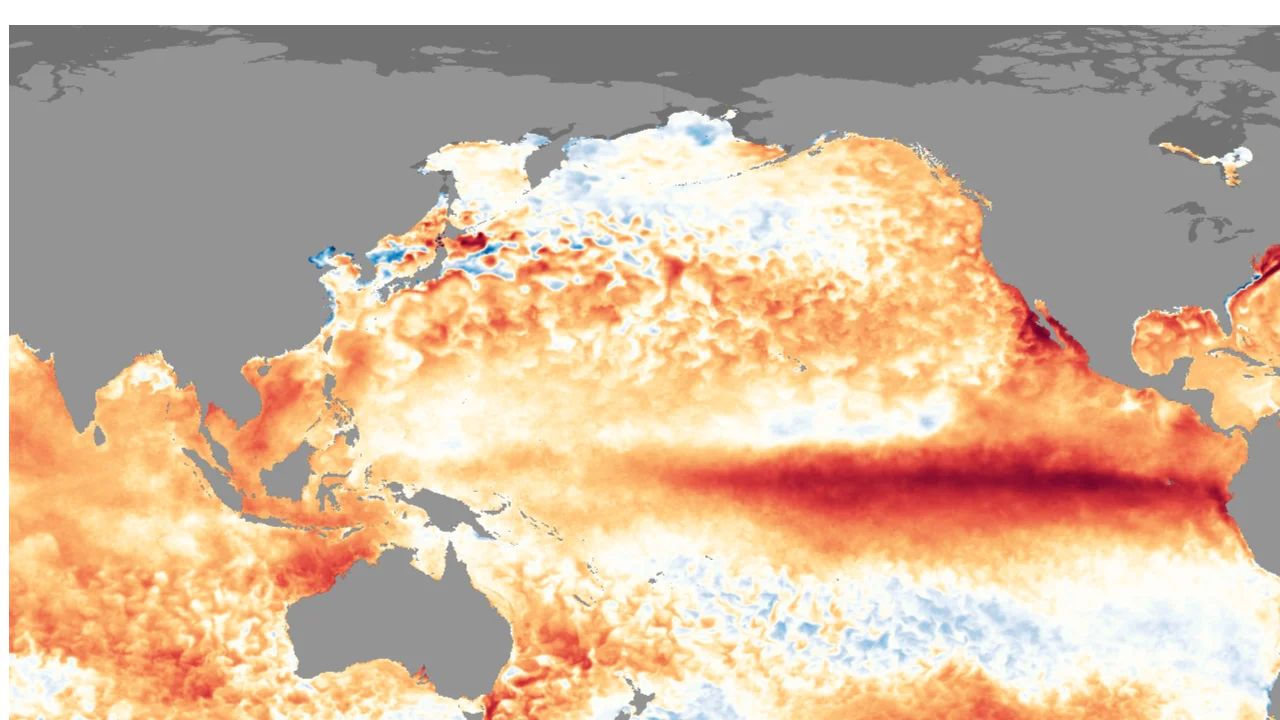
The Pacific Ocean is currently running a fever that the world hasn’t seen in generations. After a brief period of atmospheric neutrality, the equatorial Pacific is undergoing a rapid, almost violent transition toward an extreme warming phase. Meteorological agencies from the United States to Singapore are now sounding the alarm: 2026 is on track to host a “Super El Niño,” a climate event so powerful it could rival the devastating “Godzilla” cycle of 2015 or even the historic global disruptions of 1877.
As of May 7, 2026, data from the European Center for Medium-Range Weather Forecasts (ECMWF) and NOAA suggests that sea surface temperatures in the central Pacific could surge to 3.0°C above average by the end of the year. This isn’t just a seasonal shift; it is a fundamental reordering of global weather patterns that threatens to destabilize food markets, strain energy grids, and push global average temperatures into uncharted territory.
The Mechanics of a “Super” Event
For a standard El Niño to be declared, ocean temperatures typically only need to rise 0.5°C above the historical baseline. We have already blown past that. A “Super El Niño” is defined by anomalies exceeding 2.0°C, a threshold that acts as a tipping point for the global atmosphere.
When the Pacific warms this intensely, it effectively “plugs in” a massive heater to the Earth’s climate system. The trade winds, which usually blow from east to west, weaken or even reverse. This allows the warm water that normally pools near Indonesia to slosh back toward the Americas. The result is a massive release of heat and moisture into the atmosphere, which then alters the position of the jet streams—the high-altitude rivers of air that steer storms around the planet.
Table of Contents
In 2026, the transition has been uniquely aggressive. We moved from a cooling La Niña phase to an extreme warming phase in record time, leaving humanitarian organizations and governments scrambling to adjust their disaster preparedness plans.
Asia’s Energy and Agriculture Crisis
The most immediate and severe impacts are being felt in South and Southeast Asia. In Singapore and Malaysia, officials are already bracing for a “Godzilla cycle” of haze and forest fires. As the region becomes hotter and drier, the risk of peatland fires in Indonesia skyrockets, creating the potential for a transboundary haze crisis that could choke regional economies for months.
In India, the stakes are even higher. The Indian Meteorological Department (IMD) has warned that the 2026 monsoon—the lifeblood of the country’s $3 trillion economy—could fall to just 92% of its Long Period Average. For a nation where 50% of the workforce depends on agriculture, a failed monsoon is not just a weather event; it is an economic catastrophe. Heatwaves in the central and northwestern provinces are expected to break records, potentially leading to widespread crop failures in wheat and pulses.
The energy sector is equally vulnerable. Much of Southeast Asia and parts of China (specifically Sichuan) rely heavily on hydropower. During the 2022 heatwave, Chinese hydropower generation plummeted by 50% due to drying reservoirs. With the 2026 Super El Niño expected to be even more intense, energy analysts are warning of “energy rationing” and massive blackouts as populations crank up air conditioning just as the water needed to generate power disappears.
The Americas: A Tale of Two Extremes
While Asia dries out, the Americas are preparing for a deluge. In Peru and Ecuador, the arrival of warm water often triggers catastrophic flooding and landslides. Historically, “Super” events have wiped out coastal infrastructure and decimated the anchovy fishing industry, a cornerstone of the regional economy.
In the United States, the impacts will likely manifest in the winter of 2026-2027. Southern California and the Southwest, which have faced oscillating periods of drought and flood, are expected to see an “enhanced” jet stream. This typically brings atmospheric rivers—narrow corridors of intense moisture—that can dump months’ worth of rain in just a few days. While this helps refill reservoirs, it brings a lethal risk of flash flooding in areas recently scarred by wildfires.
Meanwhile, the Northern US and Canada are bracing for a “lost winter.” Forecasts suggest temperatures well above average, which would devastate the winter tourism industry and lead to an early, more aggressive wildfire season in 2027.
Africa and the Looming Food Insecurity
The Horn of Africa, which has recently emerged from a period of historic drought, may now face the opposite extreme: torrential rains and flooding. While rain is generally welcomed, the intensity of El Niño-driven storms often leads to “green droughts,” where the rain falls so hard it washes away seeds and topsoil, leaving farmers with nothing but mud.
In contrast, Southern Africa—including Zimbabwe, Zambia, and South Africa—is facing a high probability of severe drought. Maize, the regional staple, is highly sensitive to the heat and water stress that El Niño brings. Global food agencies are already warning that by early 2027, the region could face a significant cereal deficit, driving up prices and worsening an already fragile humanitarian situation.
The “Silent” Economic Disruptor: Global Shipping
One of the most overlooked impacts of the 2026 Super El Niño is its effect on global trade. The Panama Canal, a critical artery for world commerce, relies on fresh water from Gatun Lake to operate its locks. During strong El Niño years, rainfall in the canal zone drops significantly.
We are already seeing the effects. Monthly dry bulk voyages through the canal have started to decline as water levels fall. If the “Super” forecast holds, the Canal Authority may be forced to impose drastic draft restrictions, limiting the weight of ships and forcing many to take the long, expensive route around the Cape of Good Hope. This adds weeks to voyage times and millions to shipping costs, which eventually trickles down to the price of everything from electronics to grain.
Historical Shadows and the “Climate Regime Shift”
Meteorologists are looking back at 1877 and 2015 to understand the potential scale of 2026. The 1877 event was linked to global famines that claimed millions of lives, while 2015-2016 remains the benchmark for modern ecological damage, including the mass bleaching of the Great Barrier Reef.
However, 2026 carries a new, more ominous warning: the “Climate Regime Shift.” Recent studies in Nature Communications suggest that extreme El Niño events can act as triggers that push regional climates into new, permanent states. A forest that normally recovers from a dry spell might, under the stress of a Super El Niño, transition permanently into a savanna. For the Amazon rainforest, which is already nearing a “tipping point,” 2026 could be the year that permanently alters its ability to generate its own rainfall.
Moving Forward: Preparedness in the Age of Extremes
The 2026 Super El Niño is a reminder that the ocean and atmosphere are not just parts of our environment—they are the engines of our civilization. The predictability of our seasons has been the foundation of agriculture, infrastructure, and economics for millennia. When that predictability vanishes, the costs are measured in both dollars and lives.
Governments are shifting their strategies from “reactive” to “anticipatory.” In Pakistan and India, early warning systems are being used to advise farmers on “short-duration” crops that can be harvested before the peak of the heat. In Latin America, the Red Cross is prepositioning supplies in flood-prone zones.
The coming months will be critical. As the Pacific continues to warm, the window for preparation is closing. The 2026 Super El Niño isn’t just a weather forecast; it is a stress test for a globalized world that is increasingly vulnerable to the whims of a warming ocean.
Key Impacts at a Glance
- Southeast Asia: Intense haze, forest fires, and a 50% drop in hydropower potential in key regions.
- India: Monsoon rainfall predicted at 92% of average; high risk of heatwaves and “rabi” crop failure.
- Panama Canal: Threat of severe transit restrictions due to falling water levels in Gatun Lake.
- South America: Massive flood risk in Peru/Ecuador vs. extreme wildfire risk in the Amazon.
- Global Temperature: High probability of 2026 becoming the hottest year in recorded history, potentially exceeding 1.7°C of warming.
How do you plan to adjust your operations or lifestyle to account for these projected shifts in weather and supply chains?