China has formally blocked US sanctions targeting five Chinese “teapot” refineries accused of purchasing Iranian crude, marking a significant escalation in the economic standoff between Washington and Beijing over energy trade with Tehran.
In a statement released Saturday, China’s Ministry of Commerce declared that the American measures “improperly restrict business between Chinese enterprises and third countries” and violate international law. The ministry issued a binding prohibition order stating the sanctions “shall not be recognized, enforced, or complied with” by any Chinese entity.
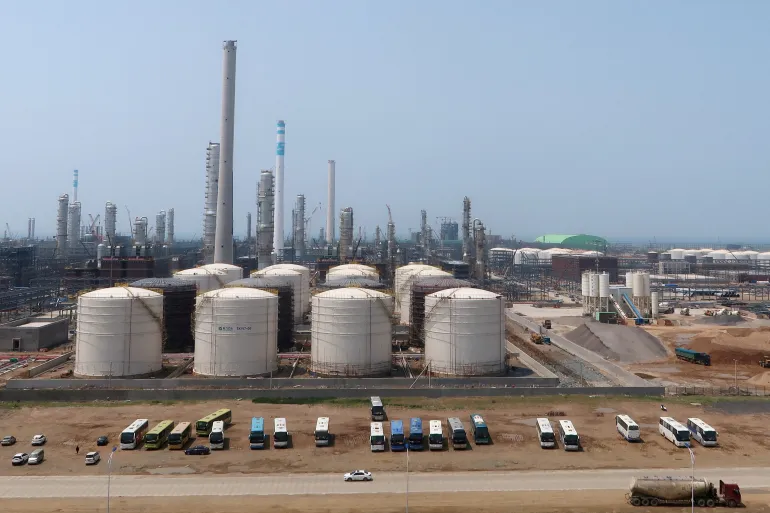
The order covers Hengli Petrochemical (Dalian) Refinery and four smaller independent operators: Shandong Jincheng Petrochemical Group, Hebei Xinhai Chemical Group, Shouguang Luqing Petrochemical, and Shandong Shengxing Chemical. US Treasury officials had designated Hengli as “one of Tehran’s most valued customers,” alleging the refinery generated hundreds of millions of dollars in revenue for Iran’s military through oil purchases.
What makes this confrontation particularly complex is the role these so-called teapot refineries play in China’s energy strategy. Unlike state-owned giants such as Sinopec, these independent facilities operate with thinner margins and rely heavily on discounted crude from sanctioned producers like Iran, Russia, and Venezuela. Together they account for roughly a quarter of China’s total refining capacity.
“Teapots have been crucial for China’s energy security strategy,” said one Beijing-based energy analyst who requested anonymity to discuss sensitive trade matters. “They allow China to diversify supply sources while securing favorable pricing. Sanctions that target them directly challenge that model.”
Data from commodities tracker Kpler shows China purchased more than 80 percent of Iran’s oil exports in 2025. With over half of China’s total oil imports coming from the Middle East, any disruption to these flows carries significant economic implications.
The US sanctions, announced by the Treasury Department in late April, bar the five refineries from accessing the US financial system and threaten penalties against any third party doing business with them. For the teapots, already operating under pressure from weak domestic demand and narrow profit margins, the restrictions create additional operational headaches — including difficulties exporting refined products under accurate origin labels.
China’s response frames the dispute in legal and sovereignty terms. “The Chinese government has consistently opposed unilateral sanctions that lack UN authorisation and basis in international law,” the Commerce Ministry statement read. The prohibition order is positioned not just as economic policy but as a defense of “national sovereignty, security, and development interests.”
Market observers note this isn’t merely a bilateral issue. The move tests how other nations navigate competing legal regimes when US sanctions conflict with domestic law or strategic priorities. Several Asian refiners have previously sought workarounds to continue trading with Iran while limiting exposure to US financial penalties.
The timing also matters. With global oil markets sensitive to supply disruptions and geopolitical risk premiums fluctuating, any escalation between the world’s two largest economies could ripple through energy prices. Brent crude futures showed modest volatility following the announcement, though broader market movements reflected multiple factors.
For the five named refineries, the immediate question is practical: how to continue operations while managing compliance risks across multiple jurisdictions. Some may seek to restructure ownership, shift trading partners, or adjust logistics to reduce visibility. Others may simply absorb the sanctions’ constraints while relying on domestic policy support.
What happens next likely depends on Washington’s response. The Treasury Department has not indicated whether it plans additional measures. But history suggests that when China issues prohibition orders of this kind, the US rarely backs down — setting the stage for a prolonged regulatory standoff with real consequences for global energy flows.
Resources
- Al Jazeera, “China blocks US sanctions against five teapot refineries,” reporting by Zsombor Peter and Reuters, published May 3, 2026.
- China Ministry of Commerce, official statement on prohibition order regarding US sanctions, May 3, 2026.
- US Department of the Treasury, press release on sanctions designations against Chinese entities purchasing Iranian oil, April 24, 2026.
- Kpler commodities data, Iran oil export flows to China, 2025 annual summary.
- Reuters, “Hengli Petrochemical complex coverage,” archival reporting on Chinese refining sector, 2018-2026.
- International Energy Agency (IEA), China refining capacity and teapot refinery market share analysis, Q1 2026 report.
- Beijing-based energy analyst interview, conducted on background, May 2026.
- UN Office of Legal Affairs, guidelines on unilateral sanctions and international law compliance, referenced in Chinese Ministry statement.
- Sinopec and China National Petroleum Corporation public disclosures, comparative refining capacity data, 2025.
- Bloomberg and Platts market commentary on Brent crude volatility following China-US sanctions dispute, May 2026.