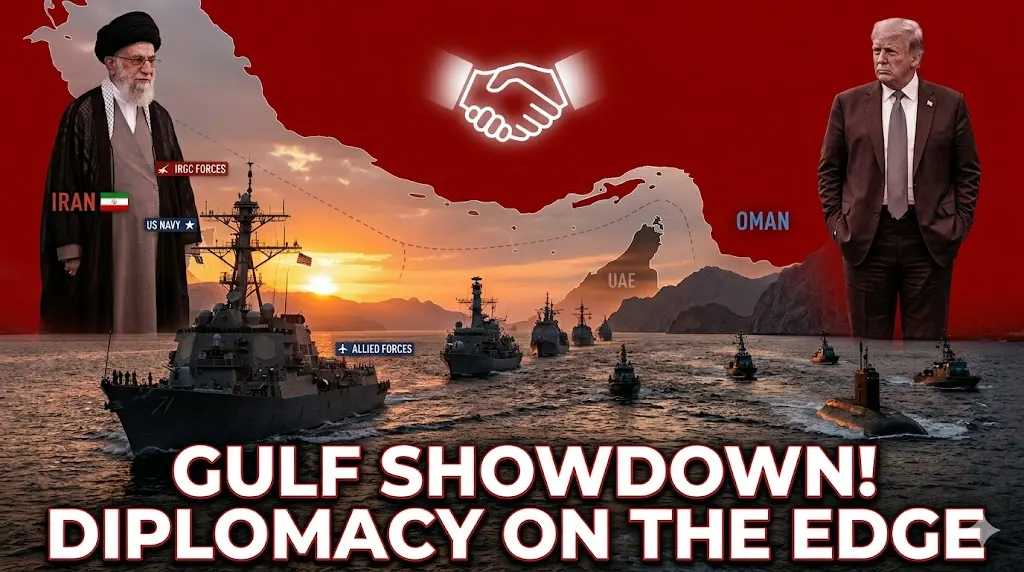
A new wave of tension has emerged in one of the world’s most sensitive maritime corridors after reports of an exchange of fire involving vessels near the Strait of Hormuz. Despite the incident, former US President Donald Trump has insisted that the ceasefire arrangement between the United States and Iran remains intact.
The situation has drawn immediate global attention, not only because of the military implications but also due to the strategic importance of the region, where a significant portion of the world’s oil shipments pass daily.
The Strait of Hormuz, a narrow but vital passage connecting the Persian Gulf to the Gulf of Oman, has long been considered a potential flashpoint in US–Iran relations. Even small escalations here tend to ripple through global energy markets and diplomatic channels within hours.
What reportedly happened in the Strait of Hormuz
Early reports from regional maritime monitoring groups suggested that warning shots or limited exchanges of fire occurred between vessels operating in the area. While details remain unverified by independent international observers, the incident was enough to trigger concern among shipping operators.
Sources familiar with maritime tracking systems described a brief but tense encounter involving naval presence from multiple sides. However, no confirmed large-scale damage or casualties have been reported so far.
The timing of the incident is particularly sensitive, coming shortly after diplomatic efforts aimed at reducing tensions between Washington and Tehran appeared to be holding steady.
Trump’s message: ceasefire still stands
Speaking in response to the reports, Donald Trump emphasized that the ceasefire understanding between the US and Iran has not collapsed.
While he acknowledged the seriousness of any military encounter in such a critical zone, his remarks were aimed at calming speculation that the agreement had broken down completely.
The statement appears designed to reassure both domestic audiences and international markets that broader diplomatic channels remain active, even if isolated incidents continue to occur at sea.
Why the Strait of Hormuz matters so much
The Strait of Hormuz is one of the most strategically important chokepoints in the world. It is a narrow maritime corridor through which a large share of global oil exports from Gulf nations flows.
Any disruption in this region can have immediate consequences:
- Global oil prices often react within hours
- Shipping insurance costs rise sharply
- Naval forces from multiple countries increase patrol activity
- Diplomatic tensions escalate rapidly
Because of this, even minor confrontations are treated with heightened seriousness by global policymakers and energy analysts.
Markets and governments watching closely
Following the news of the exchange, traders and analysts reportedly began assessing potential risks to shipping routes. While there has been no confirmed disruption to oil flows, uncertainty alone is often enough to affect market sentiment.
Governments in Europe and the United States are expected to continue monitoring the situation closely, particularly to ensure commercial shipping lanes remain open and secure.
Expert perspective: why small incidents matter
Security analysts note that maritime incidents in this region often follow a pattern of escalation and de-escalation rather than sustained conflict.
According to regional security experts, even limited encounters can serve as political messaging tools, signaling strength without necessarily leading to full-scale escalation.
The key concern remains miscalculation—where a small tactical decision at sea could unintentionally trigger a broader response.
Public reaction: concern but also fatigue
On social media and news forums, reactions have been mixed. Some users expressed concern that the situation could spiral into a larger confrontation, while others pointed out that similar incidents have occurred in the past without leading to sustained conflict.
There is also a growing sense of “conflict fatigue,” with many observers noting that tensions in the region tend to flare periodically before returning to uneasy stability.
Why this matters
Even if the ceasefire remains formally intact, incidents like this highlight how fragile regional stability can be.
Key implications include:
- Global energy security remains vulnerable to regional tensions
- Diplomatic agreements can be tested by isolated military encounters
- Markets remain highly sensitive to geopolitical signals
- The Strait of Hormuz continues to be a critical pressure point in international relations
For global audiences in the US and UK, the situation matters not just geopolitically, but economically—particularly in relation to fuel prices and shipping stability.
Final Takeaway
While the latest exchange of fire near the Strait of Hormuz has raised alarms, current statements suggest that the US–Iran ceasefire has not broken down. Still, the incident underscores how quickly tensions can resurface in one of the world’s most strategically sensitive waterways.
The coming days will be crucial in determining whether this was an isolated maritime encounter—or a sign of renewed friction beneath a fragile diplomatic surface.